
Modifications for the TR-606
Extra
memory, Dynamic Bank Switching, lithium battery, individual
outputs, audio
in to the cymbal and hi-hat circuits, accent button, snare sound modifications, noise level control, switch replacement and new
LEDs.
© Robin Whittle, Real World Interfaces rw@firstpr.com.au 15 November 2024
(2024-11-15) I have a backlog of Devil Fish work and am concentrating on this, rather than TR-606, TR-808 or TR-909 mods.
2024-11-15 update: The instructions I gave for how to install an Accent button were wrong. Below #accent are proper details.
2018-12-18 update: The Quicksilver 606 system is no longer available.
prices-tau/ Prices for Australian customers.
prices-int/ Prices for customers outside Australia.
To the
Devil
Fish page for TB-303 modifications.
To the TR-808 modification page: ../tr-808/ .
To the TR-909 modification page: ../tr-909/ .
To the Real
World Interfaces page.
To
to the main
First Principles
site.
Contents
>>> General Repairs
>>> Switch Replacement
>>> LEDs of various colors
>>> New Battery Arrangements for Retaining Memory Data
>>> 32 Banks of Memory
>>> Accent Button
>>> Individual Outputs
>>> Cymbal & Hi-Hat Audio Input
>>> Snare Modifications: Fixed or Switched
>>> Noise Source Level Control
>>> MIDI Sync In
>>> Other Mods
>>> DAY
Whenever I work on a TR-606, I clean the the case, buttons and knobs, test the machine and do any necessary repairs.
For instance, it is usually necessary to re-solder the Sync socket, the audio sockets and the white semi-flexible cables which join the front panel board to the main board. There may also be other problems to fix, such as a burnt-out power transistor in the power supply, corrosion from leaky batteries, and either fixing or replacing the battery contacts.
The Volume pot is typically noisy. Whether or not it is noisy, I dismantle and clean it with isopropyl alcohol. This should keep it noise free for quite a few years.
I install two modifications to reduce noise:
- To reduce the impact of LED noise (due to how many front panel LEDs are on) on the Cymbal and High Hat signals.
- To reduce the crosstalk between the trigger out signals, which
are always driven by the Tom channels, and the main Audio Out of the
TR-606.
In some cases with the TB-303, the pins of memory chips corrode due to the acidic or alkaline atmosphere inside the unit and the backup voltage which is on these pins. This causes erratic memory problems. If the 32 Bank Memory system is to be installed, these old memory chips will be removed, so any such pin corrosion is nothing to worry about. If not, I replace the memory chips.
Corrosion can be a problem in TR-606s due to liquid leakage from the C-cell batteries, due to them producing a corrosive vapour and/or due to some kind of inherent corrosiveness in the PCB material which is only important for the pins of the memory chips which are held at ~6V. I can generally clean up this corrosion, unless it is really extensive.
This testing, simple repairs, the two noise reduction mods, the cleaning of the case, knobs and buttons and the cleaning of the Volume pot, costs AUD$88 inc GST for Australian customers or AUD$83 via PayPal for customers oversees. Please see the Prices pages linked to from the top of this page. Other more extensive repairs such as extensive corrosion, fixing any non-obvious fault, repairing cracked PCBs is not covered by this basic charge.
Switch Replacement
The pushbutton (tactile) switches of the TR-606 are open to dust. With months and years of use, the dust compacts in the contact area, leading to erratic behaviour. I replace the original ALPS switches with a functionally similar tact switch, made by Omron. The Omron switches are sealed against dust and liquids. I expect they will last for decades.
The switches should always be replaced, even if fresh switches have just been installed – unless they are these sealed Omron switches, or the sealed ALPS switches. Ordinary unsealed ALPS switches will not last very long. I don't install the sealed ALPS switches because I do not like their feel. See: ../dfish/tact-switches/ .
Red, Orange,Yellow, Green, Blue and now White LEDs
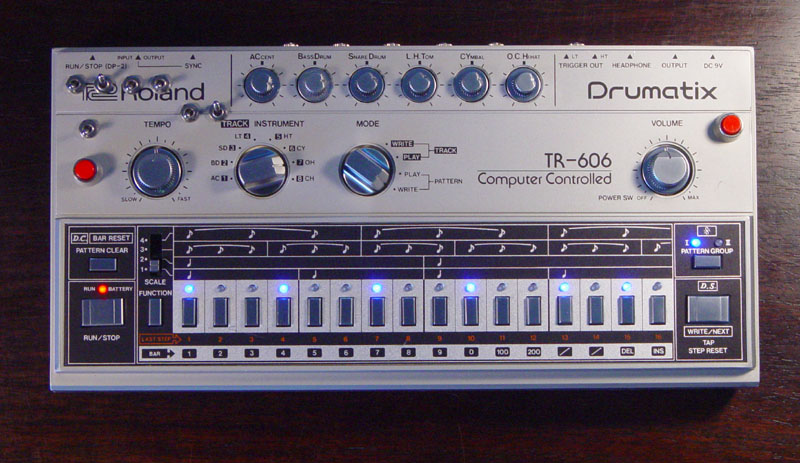
We can install LEDs in any color combination, except that if White LEDs are chosen, these generally should be installed in all 16 pattern positions, rather than just some of them. These 16 are all part of a scanning matrix, and the White LEDs are much brighter for a given current than LEDs of the other colors. We alter the resistors for the scanning matrix when we install White LEDs there. So it is possible to have all White LEDs, or a White LED in any position in combination with other color LEDs, but if you want one or more White LEDs in one of the main set of 16 switches, but not in all of these, then there will be some extra work involved.
New Battery Arrangements for Retaining Memory Data
For the details of the original arrangement (option A, a permanently installed cylindrical lithium battery) and the two new Options B and C (with a user-replaceable 2032 lithium battery) please see the PF manual: TR-606-Memory-Backup.pdf .
For both Options B and C, the C-cell batteries provide backup power to the memory system, and a new under-voltage protection circuit ensures that these will not be flattened if the machine is accidentally left running from these batteries for a long time. A large capacitor enables the machine to retain memory contents for a longer period than usual without these C-cell batteries and without the machine being run from an external power supply. There is an internal holder for a 2032 20mm x 3.2mm coin/button cell lithium battery, which can be accessed by removing the bottom part of the case. The 2032 battery should last for ten or more years. Generally, Option C is the best, with the user replaceable 2032 coin cell already installed.
32
Banks of Memory
This is functionally identical to the 32 bank system described for the Devil Fish here.
This memory system enables you to play beats from the same pattern number (1 to 16, A or B) in other memory banks while the pattern is running. This can be done by flicking the toggle-switches or pressing the pushbutton, and it can be done for one or more beats at a time, in the middle of patterns.
The result is a style of improvisatory live performance which involves dropping in beats in an intuitive manner and potentially dramatic.
There are 32 combinations of positions of the 5 toggle-switches. The pushbutton switch reverses the function of the lower toggle switch. If the internal sequencer is playing a given pattern, such as 1A, then by moving the toggle-switches you can select pattern 1A in any of the 32 banks. Since the sequencer reads from memory for each beat it plays, on the beat immediately following the change of switch positions, the sequence will read the drum and accent information from the memory pattern 1A in the newly selected memory bank. So it will play these notes from the newly selected pattern a fraction of a second after the switches have been set to the new combination. Of course when you leave the switches in a given combination, the sequencer keeps playing its patterns from that bank.
In principle, you can play from Track mode when changing banks, but this is likely to confuse the sequencer unless you very carefully organise the Tracks in all the banks you are selecting.
This system also multiplies the total amount of pattern and track memory by 32.
Please read the above-mentioned Devil Fish memory page. The simplest way of understanding this system is that the CPU in the TR-606 accesses one "bank" of memory – which is the total battery backed-up memory of the machine. The CPU accesses this "bank", but in reality there are 32 such banks, and you control which one is currently being read and written. A good analogy is that the drum machine has 32 heads, only one of which is active at a time.
The 32 Bank Memory System is also available with a two channel Dynamic Bank Switching (DBS) system. This enables one or two externally applied Audio or CV signals, (with a threshold of about +1.15 volts) via two 3.5mm sockets on the left side of the machine, to alter which of the 32 memory banks is selected. This means that the internal sequencer will play different patterns and one or more individual beats from different patterns in response to these signals.
Please see the Devil Fish 32 Bank Memory system with DBS manual, which also covers DBS for the TR-606 and TR-808: http://www.firstpr.com.au/rwi/dfish/DF-32-Bank-Mem-DBS-Manual.pdf
There is an optional centre-off Enable switch for this, which enables or disables the two Audio / CV input detector circuits, and so their LEDs and address bit inversion circuits.
Accent Button
I can install a red pushbutton switch, like that in the memory system and like the Accent button of the Devil Fish, located to the upper right of the volume control, which activates the Accent whenever it is pressed.
Individual
Outputs
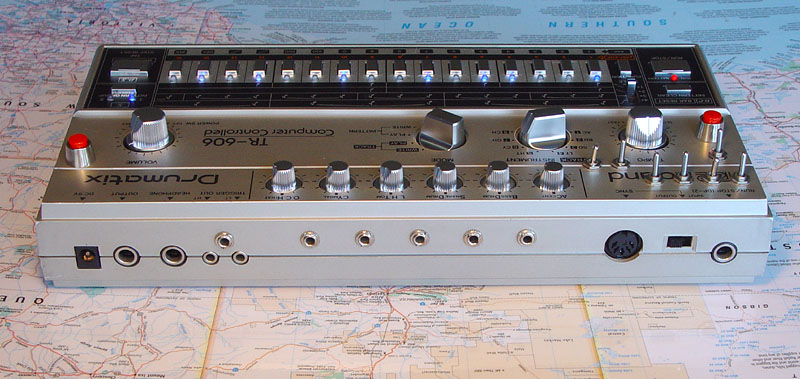
The sockets are not labeled, but each one is just to the left of the volume knob of the signal it handles.
Cymbal & Hi-Hat Audio Input
I install a 3.5mm socket on the rear panel, just to the right of the Hi-Hat volume knob. This is an audio input which takes over from the internal six square-wave oscillators which are used for the Cymbal and Hi-Hat sounds.
This is not an audio trigger. It is a sound source for being filtered, gated, distorted and filtered again when one of these sounds is triggered. If you put a bright, continuous keyboard sound such as a chord into it, then you get metallic, shimmering fizzy Cymbal and Hi-Hat sounds which are tonally and harmonically related to the chord. Low input levels result in clear tonality. Higher levels result in fizz and hiss – but the relation to the chord is still audible.
Here are some sound samples. The main long file is for those with patience. It gets pretty wild a the end. The 32 second excerpt dips into some mild-mannered and wild sounds from the long file. These are presented as SoundCloud pieces, but the compression used by SoundCloud does not allow the full sound quality to be perceived. I have provided a 44.1kHz stereo WAV files which have no such limitations and higher-bit-rate MP3 files:
SoundCloud Flash-player and link:
TR-606-cymbal-hi-hat-mods-32-sec-excerpt by Robin Whittlesounds/TR-606-cymbal-hi-hat-mods-32-sec-excerpt.wav 5.5MB
sounds/TR-606-cymbal-hi-hat-mods-32-sec-excerpt.mp3 1.4MB
SoundCloud Flash-player and link: ct>TR-606-cymbal-hi-hat-mods by Robin Whittle
sounds/TR-606-cymbal-hi-hat-mods.wav 115MB
sounds/TR-606-cymbal-hi-hat-mods-256kbps.mp3 21MB
Snare Modifications: Fixed or Switched
The Snare circuit consists of a Twin-T resonator circuit which is made to oscillate with a naturally (exponentially) decaying sine wave, due to the energy it receives from the Trigger pulse. That pulse is 1ms long and is normally about +5V. On an accented beat, the voltage can be between +5V and about +14V. On accented beats, according to the higher voltage of the Trigger pulse, the Twin-T circuit resonates at a greater amplitude initially, and so resonates for longer.
The Trigger pulse also drives a noise gating circuit. There is an approximately "white" (flat spectrum) noise source inside the machine for the Snare and Tom circuits, based on a noisy reverse-biased transistor emitter-base junction. The gating circuit has a high-pass filter to make the "snappy" noise pulse from the broad-spectrum internal noise signal.
The Fixed Snare modification involves three changes:
- Lower the frequency of the Twin-T resonator somewhat.
- Increase the mix level of the Twin-T resonator.
- Lower the filter frequency for the noise pulse, to give it more mid-frequency oomph.
- Further lower the filter frequency of the noise pulse, making it significantly louder.
| Noise switch |
Tone switch | |
| Up |
Normal. |
Normal. |
| Centre |
Noise pulse contains more mid and low frequencies and so is somewhat louder. | Tone
has lower frequency. |
| Down |
Noise pulse contains still more mid and low frequencies and so is significantly louder. | Tone
has lower frequency and is louder. |
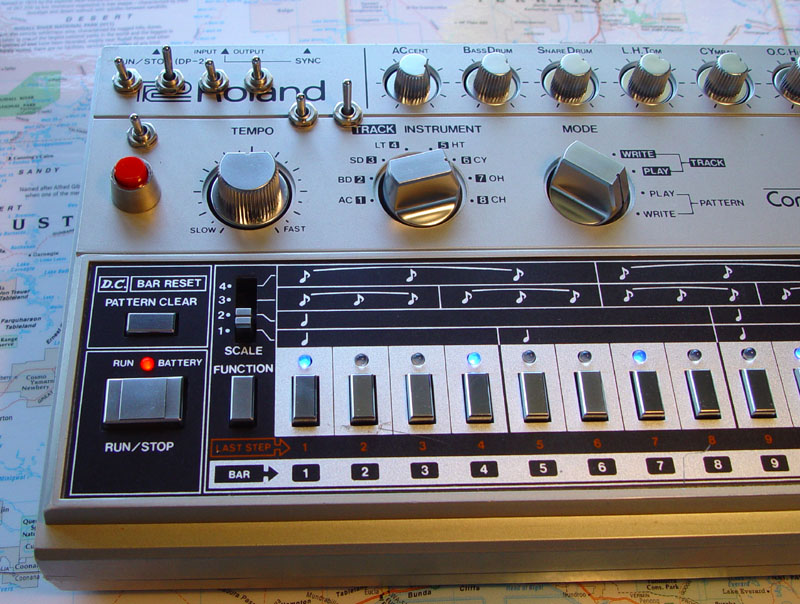
The photo below shows the two Snare toggle switches to the lower right, with the five toggle switches and the red pushbutton of the 32 Bank Memory System.
In November 2014 I developed a system for mounting these two toggle switches together with a front-panel pot (like those in the Devil Fish) for controlling the internal Noise Source. The technical description of this control is in the next section. Here is a photo of the new arrangement, in which the two toggle switches mechanically support (via a small PCB) the Noise Source pot:
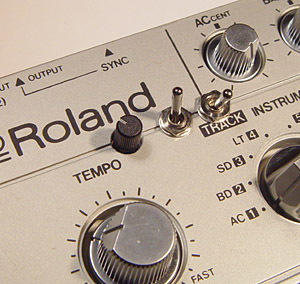
In 2015 I changed the operation of the pot so the highest noise level is produced when it is in the anti-clockwise position. This provides finer control of high noise levels on the anti-clockwise end of this logarithmic pot's range. Here is an audio file demonstrating the Switchable Snare mods and the Noise Source Level Control (as described below).
This recording demonstrates the effects of the Noise Source Level trimpot on the Toms and on the Snare. It also demonstrates the effects of the three settings of the two Snare switches, in combination with different Accent levels and noise levels. sound cloud's compression limits the high frequency detail and dynamics. I have provided a 44.1kHz stereo WAV file which has no such limitations and a higher-bit-rate MP3:
SoundCloud Flash-player and link:
TR-606-noise-snare-mods by Robin Whittle
Noise Source Level Control
The noise is used by the Snare circuit, as described above, and by the Toms. The two Tom circuits share a single gated noise circuit, with a low-pass filter, to produce a short and only just noticeable burst of rumble.
The original and less expensive version of this modification involves placing the trimpot on the bottom of the circuit board and drilling a hole in the bottom of the case where it can be easily turned with a small screwdriver. Clockwise reduces the noise level and anti-clockwise increases it. See above for audio demonstration.
As mentioned above, with a photo, in November 2014 I devised a way of doing this via a front-panel mounted miniature pot, alongside the two switches for the Snare sound controls.
MIDI Sync In and Sync Lead
I can install
a MIDI Sync In system for the TR-606, which uses the Sync Socket for
MIDI In. It also drives the Sync Socket, so it is possible to use
the Sync Lead ( ../dfish/#sync-lead)
- which is an option for the TB-303 Devil Fish with MIDI (In or In and
Out) - to drive DIN/Roland Sync to up to three other devices. If
there is no MIDI Sync input to the machine via the Sync Lead, or if the
Sync Lead is used on a TR-606 without this MIDI Sync In system, then
when the lead enables four Sync devices to be linked together.
One must be the master and the others slaves. The TR-606 will be
the master if its Sync switch (the slider switch next to the Sync
Socket) is set to Output.
Prices
prices-int/ Prices for customers outside Australia.
Other Mods
I can install a three position toggle switch which disables either the Hi Tom or the Lo Tom. The idea is that if you only want one Tom sound in the pattern, but want to use the other Tom's Trigger Out capability, without hearing that other Tom, then you can disable the sound of the Tom you are using for Trigger Out.
I do not have any mods for the kick drum or other drums which I can install inside the machine. Various things could be done, but there is almost nowhere to mount the controls. The TR-606 has an extra circuit board just behind the front panel compared to the TB-303, so a Devil Fish style front panel cannot be contemplated.
I think the TR-606 kick is a unique and excellent sound – better in some ways than the TR-808. The TR-808 has a single Twin-T resonator which rings, after being excited by the trigger pulse. In the TR-808, there is a circuit to change the frequency of this Twin-T resonator in a simple manner so the start of the sound is at a higher frequency, before switching to the lower sound. This gives an initial click or pulse-like nature to the sound.
In the TR-606, there is no such switching. There are two Twin-T resonators. They both start in phase, due to the trigger pulse, and then go out of phase since they are at different frequencies. So there is a solid start to the first cycles of both resonators, with a big positive edge – then they resonate freely and generally won't be in phase after that.
DAY
Please think very carefully before attempting electronic work on your own. The following information is not for people who are new to electronics. All the information you need is here, provided you have the required electronic skills. Please do not ask for further details! Nonetheless, if you find something here confusing and can suggest an improvement, please let me know.The switch replacement is rather tricky, because the Omron B3W-4040 tact switches have stems just a little to wide for the TR-606/TB-303 buttons. Please see ../dfish/303-mods/ for instructions on cutting two slots in the stem so it becomes springy, and will fit nicely into the TB-303 and TR-606 buttons.
The B3W-4050 switches are available from Farnell / Newark. Please see the Devil Fish page for further information. If you would like to purchase kits of 25 Omron switches cut and ready to install, please see: ../dfish/#tact_switch_kits .
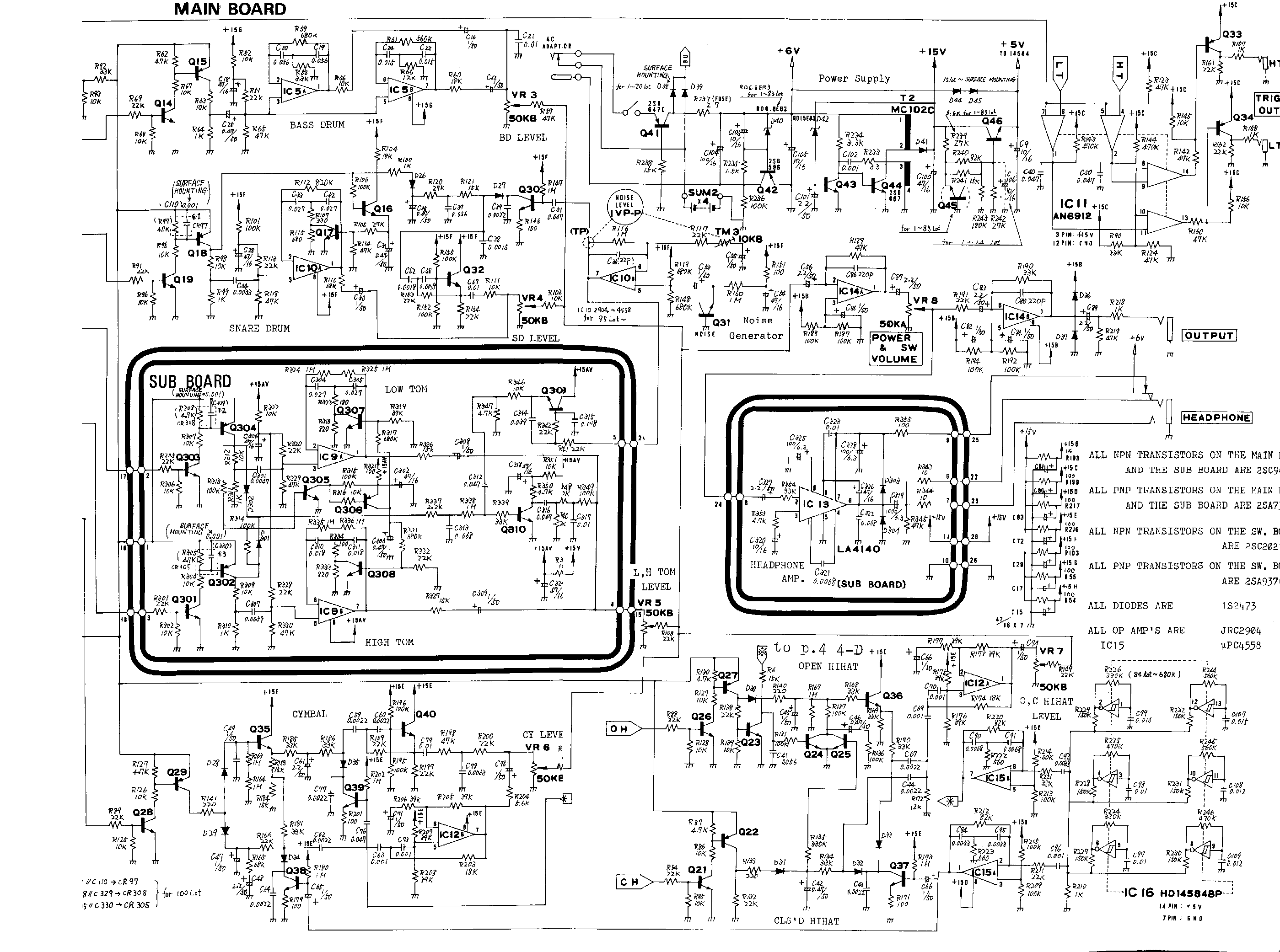
Someone has documented the individual output mod at Hyperreal, but I do not recommend this approach. ( http://machines.hyperreal.org/manufacturers/Roland/TR-606/mods/roland.TR-606.indiv-outs ). My approach involves 3.5 mm switch sockets, which take the signal after the resistor which is driven by the wiper of the volume pots. For instance this is after R57, R102, R108, R109 and R149 as shown in the schematic at: http://machines.hyperreal.org/manufacturers/Roland/TR-606/schematics/roland.TR-606.schem-6.gif . This way, the mixing bus consists of a wire running along the connectors themselves, rather than the need for a separate wire from each connector to bring the signal back to the PCB for mixing when nothing is plugged into the socket. So you have a common ground wire running to all sockets, a common mix wire, and then each socket has a wire coming from the resistor on the PCB. All you need to do is isolate the ends of those resistors from the mixing line. This involves a bit of thought, but it is obvious once you have the board in front of you. Just use a sharp knife to cut the copper tracks.
I mount the sockets between and to the left of the relevant volume control, with the socket for the Cymbal / Hi-Hat input mod to the right of the Hi-Hat volume knob. The centre of the holes should be about 8mm above the lower edge of the outside of the case.
The Cymbal / Hi-Hat input mod is straightforward. There are three wires to the socket. Ground, the signal to the socket (its "normally closed" switch contact) and the signal from it (the tip of the plug drives this, if a plug is inserted). When you plug a signal into it, the internal noise source is disconnected and your external signal drives the Cymbal and Hi-Hat circuits. You only need to cut the circuit board track at one point. Looking at the bottom right of the schematic (URL above), you need to isolate the mixing point of the six square-wave oscillators (that which is common to R227, R228, R229, R230, R231, R232 and R210) from the track which leads to C92 and C96. It is quite obvious when you look at the PCB.
There are some other mods, like making the trigger outputs be driven from the Accent and Cymbal rather than the Toms. This is obvious when you look at the schematic.
My Snare mods are as follows: Add a 0.1uF cap across C52, replace R107 with a 470 ohm and replace R110 with a 33k. This lowers the pitch of the Twin-T oscillator a little and boosts its mix level relative to the noise component.
If you are interested in weirdo snare sounds, perhaps you might like to boost the level of the snare white noise source, or provide an external input in its place so you can plug whatever you like into it. To boost the noise generator, put a resistor across R117 (say a 2.2k or a 1k) and then adjust TM3 to give a much higher level. With the TR-808, this can create really loud snare noise sounds and big rumbles in the Toms. At high enough levels, the noise breaks through even when no drum circuit is triggered.
Thanks to Adam Muntner for pointing out in November 2024 that my notes on how to install an Accent switch were wrong. Here is a sheet which describes how to do it, and also how to fix a potential problem with high battery voltage, such as from fresh alkaline cells, upsetting the accent system. It also describes how the TRIG pulse voltage, which determines the volume and character (to some degree) of the sounds, varies according to battery voltage when running from C-cell batteries.
Here are the details as a PNG image TR-606-Accent-mods.png and for easier printing, as a PF: TR-606-Accent-mods.pdf. I use the normally closed contacts of a C&K 8125 SHZBE.
If you need tiny toggle-switches, I highly recommend the C&K Tiny Toggle range, such as the T101 SHZQE solder tail, thread mounting single pole changeover switch, the double pole T201 of the special three position changeover T211, which I use in the Devil Fish until version 5.0 in 2018. http://www.ckcorp.com/ . Distributors and global parts searches are available from http://www.electronet.com/ . Some useful electronics distributors include: http://www.farnell.com/ , http://www.digikey.com/ and http://www.mouser.com/ . The T211s in solder tail configuration can sometimes be found at https://www.onlinecomponents.com .

The TR-808 and other machines
The TR-808 is an excellent drum machine. I am now doing revised versions of the Sound Mods and 4 Level Accent mods which I have been doing since the early 1980s. Please see: ../tr-808 . In March 2018 I have some sound mods for the TR-909: ../tr-909/ .
I don't have any sound mods for the TR-707, TR-727, TR-505 or MC-303, though I can install multiple banks of memory in all these machines. As with the TR-909, this memory (say 8 or 16 banks) is controlled by two push-button switches and a 15mm high 7 segment LED display. It is not possible to do the dynamic switching of banks with the MC-303, TR-909 or TR-707 which I can do with the TB-303, TR-606 and TR-808.