
32 Megabyte memory for S1000 / S1100
and S2800 / S3000 / S3200 / CD3000
Robin Whittle, Real
World Interfaces ABN 29 836 876 922, Daylesford, Victoria, Australia: rw@firstpr.com.au 31 August 2026.To the Real World Interfaces page. To the Devil Fish page – modifications to the TB-303.
Real World Interfaces is not associated with the Akai Electric Co. http://www.akaipro.com
Akai and the model numbers of their products are trademarks of the Akai Electric Co.
Intro
There are two kinds of board:
M32S1
More available in early September.
S1000 / S1100 Also the S1000KB, S1000PB and S1100EX. 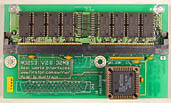
M32S3
2 in stock and ready to ship.
S2800 / S3000 /
S3200 / CD3000The S2800 and CD3000 are normally only expandable to 16 Megabytes.
The M32S1 behaves identically to four Akai 8 Megabyte boards.
The M32S3 behaves identically to four Akai EXM 3008 8 Megabyte boards. It is not suitable for the MPC3000, which uses a single Akai 2 or 8 Megabyte board and two 30 pin SIMMs. (But see http://www.forat.com, here for MPC memory.) The M32S3 and EXM 3008 boards are not for the S3000XL, S3200XL or CD3000XL – which use standard SIMMs.
One M32S1 or M32S3 board provides the maximum possible memory for these samplers:
These boards replace all other memory boards. There is no possibility of installing other boards or two of these boards.
- 32 Megabytes
- 16 Megawords
- 3 minutes 10 seconds stereo @ 44.1kHz
- 6 minutes 20 seconds mono @ 44.1kHz
- The boards behave identically to four Akai 8 Megabyte boards, so there can be no incompatibilities with different versions of firmware/software.
Installation of the M32S1 board in the S1000 or S1100 is straightforward. It plugs into any of the four slots and there is no need to alter switch (S1100) or jumper (S1000) settings on the main board.
The installation instructions for the M32S1 S10S11e.pdf includes notes on how the timing of signals provided to the memory boards by the S1000 and S1100 motherboards violates, in one respect, the requirements of the memory chips on the 2MB and 8MB memory boards made by Akai and other companies. This includes the 8MB boards I made in the early 1990s. So if these boards work, it is due to the memory chips performing beyond their specification.
This can cause intermittent or persistent distortion and noise.The M32S1 board contains its own PLL (Phase Locked Loop) oscillator and programmable logic device which generates properly timed signals for the board's memory chips. So no such noise or distortion occurs.
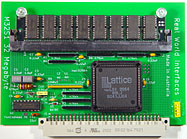
Installation of the M32S3 board in the S3000 and S3200 is also straightforward. It plugs into all four slots at once. Installation instructions: S3032-11.pdf.
Installation of the M32S3 board into the S2800 and the CD3000 without the analogue input board involves soldering several wires. The CD3000 with analogue input board involves quite a lot of extra work to remove part of a bracket which is in the way of the new memory board. In the S2800 the alphanumeric functions of two groups of buttons on the front panel (Select Prog to Help and F1 to F8) are reversed, so a little more care is required when using them to name samples etc. (Thanks to Sylvia Miller on the Akai Samplers List, 24 June 2005, for pointing this out.) Installation instructions: S28CD-11.pdf.
In all cases the installation should be performed by an experienced technician because it is too easy for non-technical people to damage either the board or the sampler itself with static electricity. A simple error such as leaving a blob of solder somewhere can cause all sorts of trouble. Installation and test takes 30 minutes or less, except for the CD3000 with analogue input board, which takes about an hour.
Pricing, availability and payment
Each board is supplied with full installation instructions (PDFs above), in a static-protective bag inside a small, robust cardboard carton.Australian customers
AUD$528 (inc.GST) for one board or AUD$$1012 for two. $15 for Australia Post Express Post with signature on delivery. Installation is free if the sampler is brought to Real World Interfaces (Daylesford, Victoria).
Customers outside Australia
Most customers use PayPal.
However, if you have a Wise.com (previously Transferwise.com) this is now just as easy to use as PayPal. The exchange rates are more favourable than PayPal and there is no 3% fee for the receiver.
The Australia Post EMS Courier service ("Express") is delivered by your country's Post Office or by a courier company such as DHL. Delivery will take between three and seven days. Your government may charge import duty and/or sales tax on items imported into your country. EMS packages can be tracked at the Auspost site.
- https://paypal.com. From your account page, use the "Send money" tab with rw@firstpr.com.au, selecting Australian Dollars. Alternatively please email us, and we will send you a PayPal invoice, which makes it easy to complete the transaction. If you don't have a PayPal account, you can still use PayPal with most credit cards, with or without establishing an account.
- https://wise.com Please email us and we will send you payment request via wise.com.
Number of
boards, with EMS courier
PayPal
Wise
1
AUD$539 AUD$523 2
AUD$992
AUD$963
Prices in USD$, Euros etc.
Mid-market exchange rates for all currency conversions can be found at: http://www.xe.com/?c=AUD . Banks and PayPal charge several percent higher than the mid-market rate.
Wise.com's rates and fees are more attractive. Their home page https://wise.com has a calculator. Select AUD for Australian Dollars in the "Recipient gets" and enter one of the values above, on the right.
Warranty
The warranty period is 1 year, or 5 years if the board is operated at temperatures no higher than 70°C (158 Fahrenheit).
Some samplers are installed in crowded racks with little or no ventilation - causing extremely high temperatures to develop inside the equipment. This greatly accelerates electrical and chemical processes which cause the breakdown of semiconductors and other components.
There's nothing particularly temperature-sensitive about these boards, but commercial electronic devices are specified to operate between 0 and 70°C. Temperatures over 70°C are excessive, unnecessary and will significantly diminish the lifetime of all electronic components. Whether or not you use these memory boards, please ensure adequate ventilation for all your equipment in crowded racks.
External fans are one way to keep equipment cool. However, the noise is typically unacceptable in a studio. Packing the racks solid with equipment will cause them to overheat, so I suggest having gaps every two items, so heat can escape from the top or the bottom of each unit.
Contact details
Telephone and postal details are at the bottom of the main First Principles page, at http://www.firstpr.com.au/#contact. Please note that Melbourne time is very different from European or North American time, so please think carefully before calling. The above-mentioned page links to timezone charts.Alternatives, other sites and loose endsIt is generally best to enquire via email: rw@firstpr.com.au mailto:rw@firstpr.com.au .
We do not manufacture or sell 8 Megabyte cards – although I used to make 8 Meg cards for the S1000 / S1100. I have no plans at present to make other kinds of memory card, SCSI interface cards etc.Software updates and manualsReal World Interfaces is not associated with Akai. Akai's web site: http://www.akaipro.com/ no longer has support material for the S series samplers. See the section below for some firmware and other items.
Sonicstate.com have an extensive list of websites related to Akai samplers: https://sonicstate.com/Synth/_inc/manlinks.cfm?manid=6.
In May 2025 I pruned links to no-longer active sites. To use archive.org to explore what was at these sites, you can follow the links from older versions of this page: https://web.archive.org/web/20250000000000*/www.firstpr.com.au/rwi/smem/.
Please let me know of any sites, mailing lists, discussion forums and the like which focus on these machines.
If you are wondering how to install 8 and 2 Meg memory boards in an S1000 or S1100, here is all the information your technician needs: 8Meg.html.
The AkaiPro site http://www.akaipro.com used to carry PDF (Adobe Acrobat) versions of manuals for many of the 20th century Akai samplers. These were in the "Support > Legacy" section, from which the particular instrument can be selected. From the resulting page, select "Docs & Downloads". These are scans from the original page images, with some of the text replaced by OCR (Optical Character Recognition) characters, which were sometimes less than 100% accurate. Unfortunately, archive.org snapshots of pages, such as from 2008 list various files but do not make them available, since there was a form to be filled in, which does not work on archive.org.
Here are PDF user manuals after I went through my archives in May 2025
Description
Akai S1000 Series Software Version 2.0 Manual
for S1000, S1000HD & S1000PB
S1000-V2.0-Manual.pdf
.
Akai S1100 Software Version 1.0 Manual
I recall there was one at AkaiPro, but I don't have a copy, and I can't find one on the Web. The S1100 is similar enough to the S1000 that the above manual probably contains most of the information needed. (However, the S1100 has a DSP card.)
Akai S1100 version 2.0 update
S1100v2.0-Manual.pdf
Akai S2800 version 1.0 manual
S2800-Manual.pdf
S2800, S3000, S3200 and CD3000 Manuals
Apart from the above, I don't have any of these manuals. I don't recall every seeing them as PDFs, and a Google search in May 2025 indicates that other people have been searching for these, without success.
This manual, for the S3200XL which is very different hardware from these earlier machines, may be useful since some of its features are similar to those of the earlier machines: Akai_S3000XL_Manual.pdf.
In 2012 and 2013 there was discussion on the akaiS1000S1100Samplers Yahoo Group (which no longer exists in 2025) about scanning a service manual for the S1000 or S1100 series. Here are 7-Zip archives of scans of the S1100 service manual and of a bunch of other files and software:
Akai-tools-various-files-from-Yahoo-Groups-akaiS1000S1100Samplers-2013.7z
33157 akaiutil-0.1win.zip
Akai Utility to access S1000/S3000 discs (by Michael Indlekofer)
939962 IB-104.zip
724240 OmniFlop201f.zip
12054 OSMAKER.zip
73753 s1000-v43-eproms.zip
74286 s1000-v44-eproms.zip
797524 S1000HD.zip
2761633 S1000Manual.zip
20996 S1000SysEx.zip
177923 s1100-202-s1100ex-136.zip
95331 S11k-430.zip
51231 tdisk216.zip
teledisk - a dos program to convert an akai sampler floppy to dos or vice versa; uses .td0 format
229745 vbrun300.zip
Here is an Akai S1100 service manual without schematics and separate file of the Akai S1100 schematics: S1100_SERVICE_MANUAL-no-schematics.pdf Akai-S1100-Schematics.pdf. See the note below on how the 1.36 firmware contains the Hardware Test Mode.
If you have any of the firmware / software I am missing, please let me know.
Real World Interfaces memory boards function identically to four 8 Megabyte Akai boards. So they do not depend on a particular version of operating system. To support Akai owners, here is some information on versions of the operating systems.
Software – the internal operating system (OS), also known as "firmware" – comes in two forms as far as the sampler is concerned. Firstly, it can be in two EPROM chips plugged into the motherboard. (EPROMs are chips which can be programmed with ones and zeroes, and then erased with ultraviolet light, to be programmed again.) Secondly the operating system can be on either floppy or hard-disk. With these, the sampler must have some version of the software in EPROM, and once it boots up and finds an operating system on a floppy or hard disk, it loads that in place of the version in the EPROM. The advantage of having it in EPROM is that there is no delay when turning the machine on. The advantage of it being on disc is that if your sampler has old versions in EPROM, you can use the latest version of software on disk without the need to reprogram or replace those EPROMs. If your sampler has a hard disk, you can boot the machine with the new OS on floppy, and write it to the hard disk.
The final versions of the software/firmware are:
S1000 and S1000KB 4.40 1994 July 24 S1100 4.30 1994 January 17 S2800/S3000/S3200 2.0 1995 March 29 CD3000 2.0 1997 October 29 Green means software on a floppy disk, which can presumably be written to a hard disk if the machine has one. (Some people use the internal or external SCSI interface to connect to a FLASH-based solid state device which behaves like a hard drive.) These are supplied as .exe files for Windows and will write to a floppy disk, which can then be used to boot the sampler. Not many people have floppy disks on their PCs these days. Furthermore, you will need Windows 98 or perhaps Windows 2000 to enable the program to directly write to the floppy disk drive. I tried one of these programs under Windows XP and there was an error: "An application has attempted to directly access the hard disk, which cannot be supported."
Black means firmware to be written to EPROMs.
The final version of software for the S1000 is 4.4. Here is a .zip file of the EPROM images for two 27C512s: akai-software/s1000-v44-eproms.zip . Version 4.3 is akai-software/s1000-v43-eproms.zip .
Here is a file with a PC .exe program which will apparently write a Version 4.4 floppy disk for the S1000: akai-software/S1000v440-FD-for-PC.zip . If you try this out please let me know how it works. Perhaps it will also work for the S1000KB and S1000PB.
The final version of software for the S1100 is 4.3: akai-software/S11V430.zip .
This PC .exe program will apparently write version 4.3 for the S1100 to a floppy disk: akai-software/S11k-430-FD-for-PC.zip (file date 1999-11-17).
[#136firmware]
In this file: akai-software/s1100-202-s1100ex-136.zip you will find the 1.36 version EPROM files for the EX1100 (the slave version of the S1100). Together with version 2.02 for the S1100, which is also in this file, the S1100/EX1100 pair, joined by SCSI cables with a hard disk, was capable of hard-disk recording. See: https://www.muzines.co.uk/articles/akai-s1100ex/9501.
Update 2025-10-21: The EPROM binary image files in the above .zip file can be programmed directly into 27C512 EPROMs - one for the least significant (AKA lower) byte and one for the most significant (upper) byte.
Two questions arise concerning the EX1100:1 - Do the 2.02 and 4.3 versions work in the EX1100? If so, they provide any additional functionality?
2 - Does an S1100 running the 4.3 firmware function as the master for a slave EX1100?
I had assumed that this 1.36 version of the firmware was specifically for the S1100-EX, which has a blank metal front panel - no LCD, buttons or analogue inputs. However, this Akai S1100 1.36 firmware works fine in the ordinary S1100.
This is probably of no interest to musicians, since the 4.3 firmware is presumably equal or superior to the 1.36 firmware.This is of great interest to technicians, since the 1.36 firmware contains the S1100 Hardware Test Mode. This is useful when repairing the machine and for adjusting the ADCs and DACs for minimum distortion and to reduce or remove DC offsets. The presentation of some of the tests is a little different than how they are described in the S1100 Service Manual, on pages 6 to 8, a PDF of which is available above.
The S1100 Hardware Test Mode is not available in later versions of the firmware 2.02 and 4.3. I assume that this is due to these later firmwares having more features and so taking up more space in the 128 KB dual 27C512 space.
One test (F1) is for the CPU memory. Another (F2) is for the waveform memory. This will test all the memory boards, both 2 MB (1 Meg word) and 8 MB (4 Meg word). The M32S1 board appears to the machine as four 8 MB boards. The test takes about 440 seconds for the full 32 MB memory.
For the S3000, and I guess the S3200 and perhaps S2800, this PC program will supposedly write a floppy disk with version 2.0 software: akai-software/S2kv2-FD-for-PC.zip (file date 1999-11-17).
For the CD3000 V2.0 OS: akai-software/cd3kv20.zip and the program to write the file it contains (Cd3kv20.td0) it to a floppy disc on a PC akai-software/teledisk.zip . Here is a standalone PC .exe program which will apparently write to a floppy disk too: akai-software/Cd3-200-FD-for-PC.zip .
Here are the EPROM images for the CD3000 V2.0, in two binary files for the two 27010 EPROMs: akai-software/CD3000-firmware-V2-for-27010-EPROMs.zip (I have not tested this, please let me know if they work or not) and in two 64k chunks per chip, which is how I read them in 1997: akai-software/Akai-CD3000-V-200-EPROMs.zip.
A version 2.0 EPROM image for the S3000XL are here: S30XLV20.zip This is the top 256 kbytes of a 512kbyte 27040 EPROM - I have been told it works fine if you load it in at offset 0x40000, leaving the bottom half of the chip empty. Version 1.06 and 1.50 (courtesy of Steve Charman) are believed to be good: S3000XL-1.06-1.50-eproms.zip These are for a 32 pin AMD AM27C040. Steve wrote "V1.5 was the last real update as V2.0 addressed the SCSI transfer stuff for MESA - and thats all as far as I am aware."
At the AkaiPro site http://www.akaipro.com/s3000 there used to be some other files which I did not make available until 2018-05-06. I saved them some years ago, and now they are no longer at that site, here they are. I had written of some of these files "there are also PC and Mac (no-doubt for now obsolete hardware and software) versions of MESA, which I understand could control S3000 and S3000XL series via SCSI, including sample editing."
akai-software/akaipro-2006-archive-os.zip I created this zip file in 2013, but all the constituent files are from 2005-03-29 which is when I would have downloaded them. I haven't tried to figure out what they all do. Please let me know if you find out for sure what they are, and to what extent they work.
1_re32v101.zip 379,154
2_dr16pv320.zip 440,848
2_mpc2kv172.zip 166,069
aksysf17.zip 6,988,360
aksysl17.zip 3,866,551
Cd3-200.zip 119,977
CD3XV20.zip 137,507
dp6v302.zip 566,043
DPS12V2.11.zip 366,482
mesa2v2.zip 4,689,800
midiload.zip 13,739
Mpcv311.zip 179,464
osldr_4k.zip 33,199
Osm2201.zip 1,880,002
S1000v440.zip 73,938
S11k-430.zip 95,331
S2kv2.zip 128,445
S3k-2.zip 132,497
S3xlv2.zip 155,513
s56v214.zip 407,986
Z48_145.zip 910,609
aksys17f.sit 5,440,952
aksys17l.sit 1,867,341
MacXOSLoader.sit 176,200
MESAII.INS.sea.sit 777,031
osldmac.sit 101,532
OSM2210.sit 47,675.
In May 2025 I extracted these Akai sampler manual PDF files from an archive I made of the AkaiPro site in 2006. Some of these have OCRed text, with potential errors.
ak.sys Version 1.70 User's Guide Addendum
MD280 Sampler Disk Drive
S5000/S6000 Software V 1.21 with addenda
S612 Sampler
S900 Sampler
S950 Sampler
S1000
S2000
S3000XL
S3200XL
Akai memory board part numbers as search-engine bait: EXM005 EXM 005 EXM-005 (2M for S1k) EXM008 EXM 008 EXM-008 (8M for S1k) EXM3002 EXM 3002 EXM-3002 (2M for S3k) EXM3008 EXM 3008 EXM-3008 (8M for S3k).