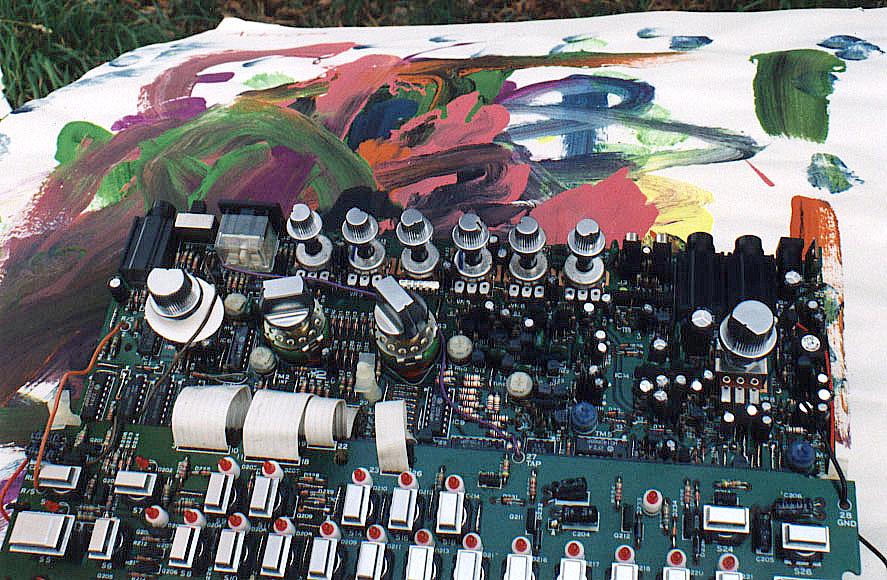
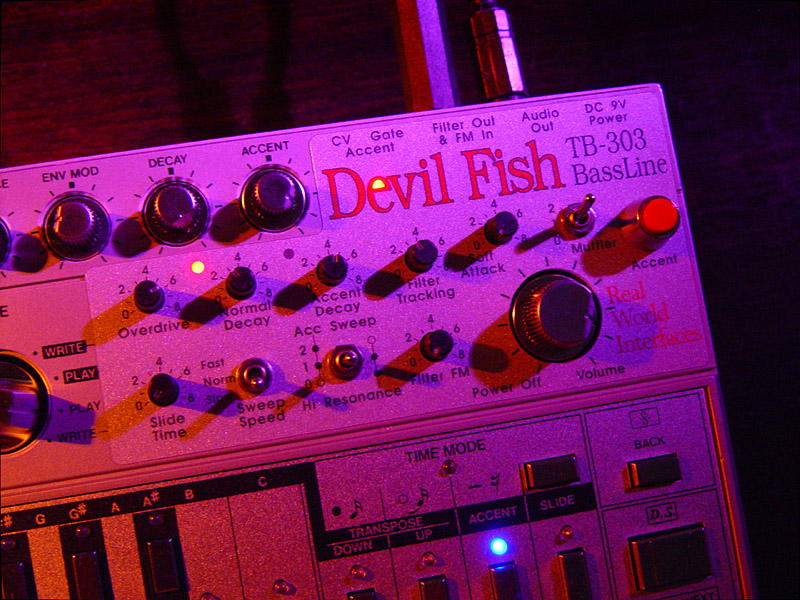
| This is the home page of Robin Whittle's Devil Fish modifications for the Roland TB-303 Bassline. Ollie Olsen (1958 - 2024) inspired the original Devil Fish: Ollie-Olsen/. Please see the research concerning vitamin D3 and the immune system, cited and discussed at: https://vitamindstopscovid.info/00-evi/. |
© Robin and Tina Whittle, Real World Interfaces, Daylesford, Victoria, Australia 19th April 2026
Devil-Fish-Manual.pdf
Devil Fish User Manual. Versions 5.0 and 5.1 include a 3.5mm headphone socket and a low voltage dropout system to protect the C-cell batteries from being completely discharged if the machine is accidentally left running from these batteries for several days. The three toggle switches of 5.0 / 5.1 Devil Fishes look the same as those of earlier versions, but are of a different type with a more definite 3 position feel. They should retain this feel for decades, whereas the three positions of the previous switches tended to become less definite with a few years use.
DF-Memory-Backup.pdf
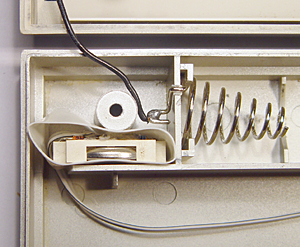
Battery arrangements for retaining memory data in the Devil Fish.
Instead of the cylindrical, soldered-in, non-rechargeable lithium battery we used until late 2016, TB-303 Devil Fish memory data is now retained with a user-changeable 2032 non-rechargeable lithium coin cell. These should last for at least ten years and can be easily replaced by removing the back panel. The system also includes a large capacitor to keep memory data alive for several days in the absence of power, C-cell batteries or the lithium battery.
DF-MIDI-In-Manual.pdf
Manual for the MIDI In System V1.0.4. DF-MIDI-In-Out-Manual.pdf
Manual for the MIDI In and Out System with Dynamic Bank and/or Channel Switching.
The MIDI In and Out system has numerous capabilities, including the ability to operate as a CV to MIDI converter. Dynamic Channel Switching involves switching the Devil Fish synthesizer and MIDI Out between the notes received on four contiguous MIDI In channels, according to MIDI commands, toggle switch movements and two Audio or CV inputs.
DF-MIDI-In-1.0.3-Manual.pdf
Manual for the MIDI In System V1.0.0 to V1.0.3. This includes descriptions of and workarounds for two bugs: MIDI In notes are played 1 semitone higher than they should be and invalid data may be written to the non-volatile memory which stores the settings for the MIDI In system. DF-32-Bank-Mem-Manual.pdf
Manual for the 32 Bank Memory System. DF-32-Bank-DBS-Mem-Manual.pdf
Manual for the 32 Bank Memory System with Dynamic Bank Switching (DBS) or Dynamic Bank/Channel Switching (DBCS, with the MIDI In and Out system).
midi-options/ This covers the Devil Fish MIDI In system and the Devil Fish MIDI In and Out system. The Sonic Potions MIDI In and Out CPU replacement system is another possibility.
sounds/ Sound samples.
photos/
Photos of Devil Fishes. videos/ Videos of Devil Fishes in action.
ECO/ Engineering Change Orders - technician-installable hardware changes to solve problems with Devil Fishes which we discovered after shipping the machines to their owners. Also, in some cases, workarounds to get around these problems without hardware changes. TT-303/ Information on the Cyclone Analogic TT-303 Bass Bot.
Please do not press down on the six small knobs of the Bass Bot while turning them! This can cause the pot's rotor to cut through the conductive tracks. The same is true of the TB-303's original pots.
prices-au/ prices-int/
Prices for customers in Australia and overseas.
../tr-606/ ../tr-808/ ../tr-909/
TR-606, TR-808 and TR-909 modifications.
../smem/
32 Megabyte memory boards for Akai samplers.
|
19th April 2026 I have not been able to do much electronic work recently. I am not taking on any new work until I have finished the jobs in hand and caught up on correspondence with potential new customers. I apologise for these long delays. Sound to Parts www.soundtoparts.com/en/tb-303/1159-tb-303-complete-case-and-hardware-roland.html can now supply TB-303 replica cases. These are high quality, injection molded ABS cases made with the die sets used for the Cyclone Analogic TT-303, with the necessary modifications to make the front panel suit a TB-303 - or an RE-303. This includes an aluminium switch plate to accommodate 3mm LEDs. The kit does not include knobs or buttons (tact switch caps), but these are available from Sound to Parts, based on the quality chrome-plated ABS knobs Cyclone Analogic made for the TT-303. One notable improvement with these reproduction cases is that the silver paint seems to be a conventional, robust, automotive finish. The original Roland cases had a curious, somewhat matt finish paint, which I think was achieved by having the aluminium particles partly exposed on the surface. This lead to the surface becoming grubby and dull with use. The TT-303 cases, and now these reproduction TB-303 cases, have a conventional, glossy, finish which I think will last well. Check out the Michigan Synth Works LRB-303 kit: The board is 4 layer (internal layers for power supply and ground) and closely resembles the TB-303 board, which is double sided without plated through holes. The LRB-303 board has holes for through-hole components, but generally there is no need to use them, because the surface mount versions of these components are already mounted. This greatly reduces the effort in assembling the machine and avoids all sorts of trouble trying to order ordinary and obscure components. The Sync socket with dual normally closed contact switches is a 3D printed design. Cases for this are available from: jlc3dp.com/3d-models/detail/MX13464-LRB-303-Synthesizer-Enclosure. These are 3D resin printed, not melted plastic, fused deposition. JLC3DP does all the screen printing too. I am still trying to figure out how to bring most doctors and government health authorities up to speed on the need for proper vitamin D3 supplementation, to attain at least the 50 ng/mL (125 nmol/L) circulating 25-hydroxyvitamin D level which the immune system needs to function properly. Please read the research for yourself: vitamindstopscovid.info/00-evi/. It is exhausting even thinking about how to adequately describe all the dimensions in which the US/Israeli war on Iran sucks. President Trump has taken charge of the Strait x.com/IRanMediaco/status/2040441742781235350 and sings melodiously about blockade while tweaking the knobs of his original DX7: x.com/IraninSA/status/2043757392010076666 One thinks of Zoot. Earlier items, from April 2024 SoundToParts.com in France, which is closely associated with Cyclone Analogic, has a small number of new old stock Bass Bot TT-303 version 1 machines for sale. We will be able to modify these for the basic Devil Fish mods, but not for 32 banks of memory, and probably not for the Devil Fish MIDI In or MIDI In and Out systems. I am completing Devil Fish mods for an RE-303: https://shop.re-303.com which is in a TR-606 case. Electronically, this is the same as working on a Roland TB-303. However:
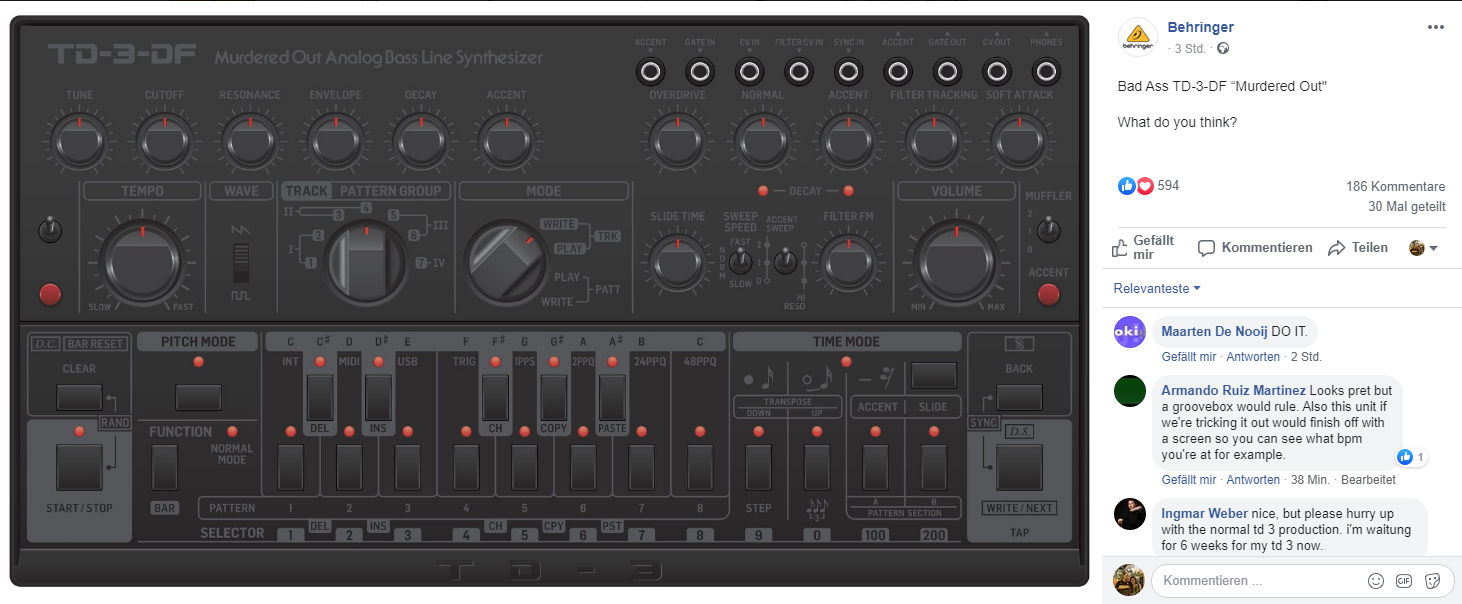
31th May 2022 We were considering modifying the Behringer TD-3 but decided against it. The Devil Fish mods are applicable to the RE-303 http://re-303.com . There should be no electronic problems modifying them since the circuit board design is based directly on that of the TB-303. The 32 Bank Memory system and the Devil Fish MIDI In and MIDI In and Out systems are only applicable to machines with an original TB-303 CPU. We have not yet had an RE-303 in the workshop. Unfortunately the aluminium cases for the RE-303 seem to be unsuitable for the Devil Fish mods. We plan to fabricate our own cases, from ABS sheet. but this is a project for the future, once we are up to speed working on TT-303s. When doing the Devil Fish mods for the two MIDI enabled machines mentioned above: the TT-303 V1 and the RE-303 with its Sonic Potions CPU replacement we will include a microcontroller to receive a MIDI In control change to drive the Filter frequency. The default controller will be Mod Wheel. It may be difficult to provide controls to alter this. Can anyone imagine a situation in which they really need the Filter frequency control to be on some other controller number? 5 February 2020: A customer sent us a screenshot from Behringer's Facebook page with a CAD-generated image (not a photo of an actual object) of a "TD-3-DF" which resembles a TD-3 with all the Devil Fish controls, inputs and outputs, in a brooding, dark colour scheme. Sure enough, we found this on the abovementioned page. The screenshot is here. You can read our response to this posting, and the background to it, in a separate page behringer-unauthorised/ . We updated this when Behringer went into production with the TD-3-MO. Apart from the sub-oscillator, this is a direct unauthorised copy of the Devil Fish circuitry - though I have not seen one, so they may not have included the ECO updates. They mis-attribute the design to "third party mods" as if these were floating around, as many instructions for modifications are. They were too dim to provide MIDI control of filter frequency. Our dispute is with Behringer management, not those who purchase these machines. 18 December 2018: The Quicksilver 303 CPU replacement system, with MIDI In and Out, is no longer available. I will try a Sonic Potions CPU replacement system ( https://www.sonic-potions.com/re303 ) which also has MIDI In and Out. This can't provide Filter Frequency control (as is done by the Devil Fish MIDI In and MIDI In and Out systems, and which the Quicksilver 303 system also provided) and there is little prospect of it doing so in the future since there are no pins available for the requisite PWM signal. Roland's TB-03 does not use analogue circuitry. Instead of the transistors and integrated circuits which produce voltages for audio and control, with the filter being done by transistors (operating as diodes) as the vertical segments of a ladder, with capacitors as the rungs, all the sound generation and control is done with digital calculations. This is no-doubt a good, reliable, compact and cost-effective way of producing sound, but it is not at all amenable to modifications such as the Devil Fish. 7 February 2016: I have added an ECO directory, as mentioned above, for technician-installable hardware changes to correct problems in Devil Fishes which we discovered after sending the machines to customers. Devil Fish owners: please take a look at this page to see which of these problems may apply to your machine. 15th September 2014: I have completed the MIDI In and Out system, with its Dynamic Bank and Channel Switching capabilities. See the Devil Fish MIDI In and Out Manual (the link is above) for the full documentation of these. 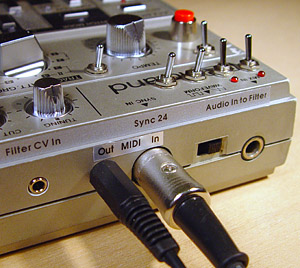 One of three modes of MIDI Out operation is automatically selected: Int Seq mode
Note pitches result from the Internal Sequencer when it is playing a
pattern, in Pattern Write, Pattern Play, Track Write or Track Play
modes.
Ext CV mode Note pitches result from measuring the voltage of an externally applied Pitch CV, plugged into the CV In socket – or, if no lead is plugged into this socket, by measuring the internally generated CV (from the TB-303’s 6 bit DAC) which results from the Internal Sequencer playing notes during Pattern Write mode when it is not playing the pattern. This is when the user is entering and altering pitch, timing, Accent and Slide information. MIDI In Follow mode When the MIDI In system has reception of Notes and Control Changes ON (hold TAP and press and release BACK), the MIDI Out system replicates via MIDI Out Note On and Off messages the notes the MIDI In system is playing on the Devil Fish. This includes the way notes are generated with Dynamic Channel Switching. For full functional details of these modes, please see the MIDI Out further explanation section of the user manual. Here is a description of the the 32 Bank Memory system and how it can work with the MIDI In and Out system and two signal inputs which detect in an on/off fashion CV voltages or an audio signals. For the TB-303 Devil Fish (with or without the MIDI In and Out system or the MIDI In system), for the TR-606 and for the TR-808, Dynamic Bank Switching (DBS) enables two external Audio/CV signals (or potentially four for the TR-808) to alter the currently selected memory bank, instantaneously. This is done by detecting the signal exceeds about +1.15 volts, and using this to invert one of the five address bits which select which of the 32 memory banks is currently accessible to the Internal Sequencer. You can hear DBS in action with both the Devil Fish TB-303 and a TR-606 in Lincoln Webber's late 2015 video: https://youtu.be/FV9g7xBsPYA . An earlier video, mentioned below, https://youtu.be/grjqTnyf8Ss shows how it works with the Devil Fish. The following description concerns memory bank switching, but the same two inputs, detector circuits and switches can also be part of Dynamic (MIDI In) Channel Switching, in Devil Fishes with the MIDI In and Out system. The primary purpose of this is to enable switching between patterns, moment-by-moment, in response to manipulation of the toggle-switches and pushbutton and in response to external audio or CV signals. Since the Internal Sequencer reads from memory every time it plays a note, this means that notes from patterns in various memory banks can be played in the middle of patterns. The manual for this is above: #MEMDBSMAN . The only visible parts of this are two 3.5mm sockets on the left of the machine, and two LEDs, which, when on, indicate that the detector circuit has been activated and that the address bit from the corresponding toggle-switch will be inverted before it is used to select one of the 32 memory banks. 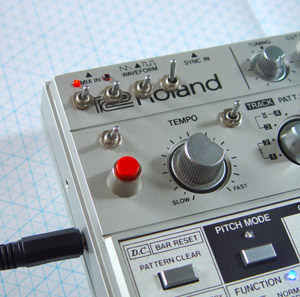 Here is a description of Dynamic Bank Switching (DBS) for the TB-303 Devil Fish, which involves just the switches, input sockets and LEDs - not the MIDI functions. The same capabilities will be possible for the TR-606 and in 2 and 4 channel versions for the TR-808. The DBS hardware for consists of two 3.5mm audio or CV input sockets on the left of the machine. Whenever the audio or CV input signal becomes more positive than +1.15 volts (which high level audio signals will exceed in the positive part of their waveforms), the circuit turns on. The circuit remains on for about 33 milliseconds after the input signal goes below the +1.15 volt threshold. So audio signals of 30Hz and higher (and somewhat lower, depending on the waveform) will produce a continual On state as long as part of their waveform exceeds about +1.15 volts. The inputs can handle -15 to +15 volts. When the detector circuit is On, its Red LED is On and the address bit which is generated by the associated toggle-switch is inverted. If the detector circuit is Off, everything is as per normal: The low and high positions of the toggle-switch produce 0 and 1 respectively for the address bit. This is one of the 5 bits which selects one of 32 (2 x 2 x 2 x 2 x 2 = 25) memory banks, numbered 0 to 31. When the detector circuit (and so the LED) is On, the low and high switch positions produce 1 and 0 respectively, thereby selecting a different memory bank than when the circuit is Off. Each of these sockets, detector circuits and LEDs is like an audio or CV controlled version of the Red pushbutton switch of the 32 Bank Memory system. That pushbutton inverts the address bit produced by toggle-switch 4. The two new inputs invert the address bit produced by toggle-switches 3 and 2. This means audio or CV signals can switch the Internal Sequencer from playing a pattern in a particular bank of memory to playing the same pattern number in some other bank of memory whose 5 bit address differs in one bit. Since the Internal Sequencer looks into memory for each note it plays, this means that the notes it plays, with Accent and Slide, can chop and change between those from patterns in multiple banks of memory, in the middle of a pattern. The Devil Fish synthesizer and, if it is installed, the Devil Fish MIDI In and Out system and its one more slave devices, will play this set of notes. Lincoln Webber has has posted an annotated demo of using this Dynamic Bank Switching (DBS) system: In this demo he is using as inputs a CV from an LFO and the Accent CV out of the Devil Fish itself. He is not using audio signals as inputs or driving a slave device from MIDI Out. In this configuration, the Accent signal is coming from him pressing the Accent Button or from any Accents which may be programmed into the pattern. A simple and elegant approach is to alternate between two patterns with an LFO which is running with a cycle just a little slower or faster than the pattern time itself. Lincoln is doing this with one of the signals. Since there are two channels, there are four patterns which can be selected by the four combinations of the two input signal states. One or both input channels could be MIDI controlled by driving any MIDI synthesizer with Note On and Off events and using its audio signal, perhaps through an amplifier if its positive peaks do not already exceed about +1.15 volts. With the MIDI In and Out system, if nothing is plugged into an input socket, the output of the socket (the input to the detector circuit) can be driven by a signal derived from MIDI In: Note and/or Control Change messages received on Channel 15 or 16. Other sources of signal to drive these inputs include: CV or audio from modular gear; talking into a microphone, the signal of which is amplified to a suitable level, and: using some audio, including from the Devil Fish or a slave instrument and delaying it. Also, using a brief audio signal into one input and a delayed version it into the other. Then a pulse of audio will take the memory system through four memory banks: Pulse - invert A2: 0000001111110000000000000001111111100000 Delayed - invert A3: 0000000001111110000000000000001111111100 Bank number: 0 0 0000 ------ ------------ -- 4 0 0100 --- --- 8 0 1000 --- --- 12 0 1100 --- ----- Address bit 4 3210 Time ------------> The above timing chart is for all switches being down, with the pushbutton not activated. At any time these can be activated, and in the case of switches 2 and 3, this would invert the bits shown above, thereby selecting different banks. I was prompted to devise this modification by discussions with Ricardo Velarde and Lincoln Webber. Lincoln has some other Devil Fish videos here. Here is some more information about the MIDI Out functions of the MIDI In and Out system. In MIDI In Follow mode the Accent Button and/or the Accent CV In socket adds Accent to MIDI Out notes where these are generated from MIDI In notes without Accent. This replicates the behavior of the Devil Fish synthesizer by ignoring the Accent state of the Internal Sequencer, which might be on due to the sequencer having stopped on an accented note. I have also added:
|
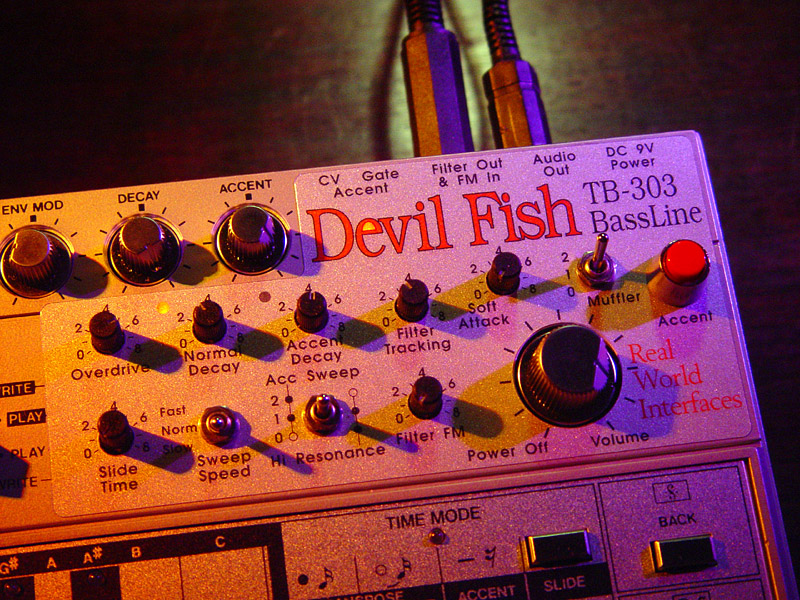
Today I passed it over to the band.  They went mad.  Immediately they
locked the studio and started to build sounds.  Nobody can stop them now.
They are very happy and they say thank you thousand times!
I want to let you know I am successfully exploring what the Devil Fish
has to offer.  And it IS overwhelming...  I've owned plenty of
synthesizers before but... I've never imagined a "relatively simple"
synth such as my Teebee will transmute into such a miracle.

Also, I've noted that the Devil Fish is very capable of creating clicky
sounds with low decay values.  They can be very useful for percussion
and other things.  What's more, the resonance and muffler settings can
get relatively thin sounds, this feature can be utilized to fit more of
the Devil Fish "juice" into the mix. More tracks, more layers, more
textures.

I begin realize that it's, in fact, possible to create a lot of
layeristic stuff - create entire soundscapes using only the Devil Fish
and outboard effects.
Oh by the way you probably know this....  You can change MIDI modes and
reset while machine is running so you can turn off/on MIDI reception
during a track, its really neat I use it a lot, as well as running the
Accent Out to an attenuator(Moogerfooger CV processor) and out back into
the Devil Fish Slide In and I can Turn the Att. up and down to turn on
Slide/Gate etc...thats fun also the CV processor has a Square/Triangle
L.F.O which I often use for the CV filter in for rhythmic filter sweeps
and other crazy fast bell like effects when turned up full and I love
using the mod wheel to filter it means I do real dramatic filter stuff
without killing the D.F.'s Cutoff knob and also be able to freak it out
and return to the exact same sound setting.....Endless...........
Sound samples are at: sounds/linxstar/ . Seven years later (2013), from and undisclosed location in the Dandenong Ranges, with
occasional transmissions via YouTube, and soundcloud.com/linxstar/ Linx writes:
and in many other countries, musicians have placed themselves in the care of the Devil Fish.I have at the moment (even as I'm writing this) a convoluted modular
patching arrangement between the Devil Fish and three Moogerfoogers -
CP251 control processor (receiving and sending CV to/from-the Devil
Fish, MF-101 lowpass filter, MF104z delay (which is receiving the audio
out of the Devil Fish and is in a feedback loop, using the delay signal
only to the lowpass which in turn is sent to the DF audio in to filter.
The CP251 is also sending noise to the FM in (there is only the slide
in and accent in not being used). The DF CV out is controlling the
feedback on the Delay. The Accent out is used to trigger the sample &
hold unit in the CP251 and the Gate out is modulating the env amount on
the lowpass. Its creating a percussive acidy snarey rhythmically
changing delay with a twist. I'll record this tomorrow, I probably
should have today as at one point when I stopped the sequencer the CP's
LFO and S&H kept triggering the DF and MF's and it was quite
interesting how it all evolved.
|
The Devil
Fish
is
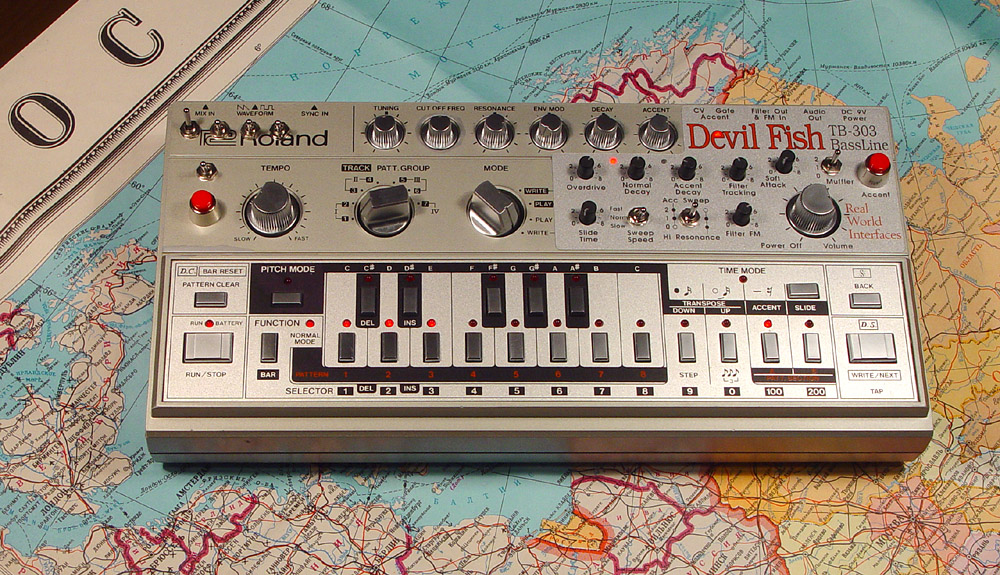
a modification to the TB-303 - a
synthesizer/sequencer produced
by Roland
in 1981/82,
which has
played a crucial role in the development of electronic dance music. A
detailed
description of the Devil
Fish
can be found in the User Manual Devil-Fish-Manual.pdf
.
Features include:
* These three audio signals are
connected in the following manner:
The Audio
In to Filter signal is plugged into the old 6.5mm mono Mix In socket,
on the left of the rear panel. There is an option (see below) for a three position toggle-switch to
control this signal.
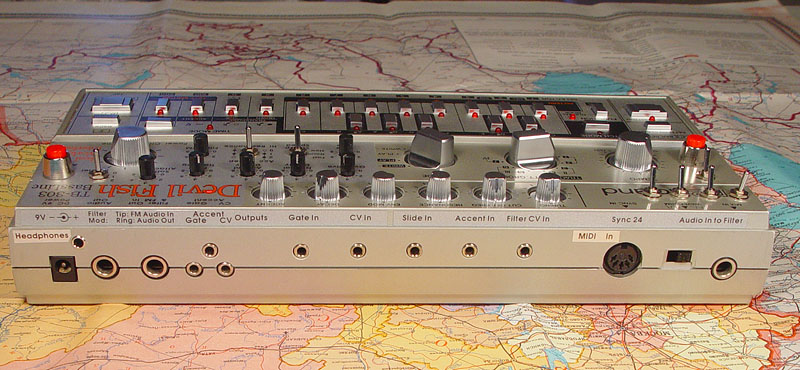
The Audio In to Frequency Modulate the Filter signal is plugged into the old Headphone socket, with the tip of the socket accepting this signal. This means a mono 6.5mm plug can be used for this function. The Audio Out from Filter signal is driven to the ring of the old Headphone socket. There it can be accessed with a suitable stereo plug, or by partially inserting a 6.5mm mono plug. To make it easy to use the Audio In to Frequency Modulate the Filter and the Audio Out from Filter, the Devil Fish is supplied with a special lead with a 6.5mm stereo socket and two 6.5mm mono plugs on a Y-lead. |
The optional 32 bank memory system enables switching between banks while a pattern is playing. So the sequencer reads the next note from the same pattern number in the new bank. This enables much more interesting and unexpected results than are obtainable by having the sequence change from one pattern to another, which it only does at the end of each pattern.
Full details: DF-32-Bank-Mem-Manual.pdf .
There is a second version of the 32 Bank Memory System manual which covers Dynamic Bank Switching (DBS if there is no MIDI In and Out system) or Dynamic Bank and MIDI In Channel Switching (DBCS), if the MIDI In and Out system is installed: DF-32-Bank-Mem-DBS-Manual.pdf . The DBS/DBCS versions of the 32 Bank Memory System can be fitted with an optional Disable Switch, which enables or disables the detectors of the two approximately +1.15 volt Audio/CV input sockets. This switch is normally mounted to the right of the Tempo knob.
Up
Detector circuits and their LEDs and address bit inversion circuits are enabled.
Mid
They are disabled.
Down
They are enabled, but this is a momentary position, with spring return to Mid position
The optional MIDI In and MIDI In and Out systems use the existing Sync socket, and receive Sync, Notes, Accent (depending on the note's velocity), Slide (from MIDI controllers or tied notes) and Filter Frequency (from a selectable MIDI controller number, defaulting to Mod Wheel). Full details: Devil-Fish-MIDI-Manual.pdf
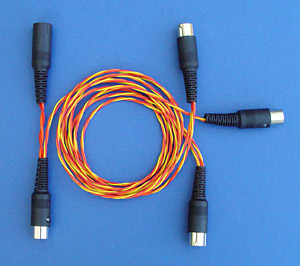
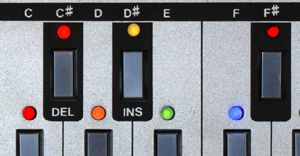
There is also a special Sync Lead which accepts MIDI In, and provides a daisy-chain of three Sync out connectors to drive, for instance, devices such as other TB-303s or Devil Fishes, TR-808s or TR-606s. See the sync-lead/ page.New LEDs in Red, Orange, Yellow, Green, Blue and White: leds/ .
We suggest all Blue LEDs, except for the Run/Stop LED, in which we install a new Red LED. These are a broader blue spectrum than most blue LEDs, with more violet – a somewhat different colour than the slightly aqua color of most blue LEDs. They are also a good brightness, whereas the ordinary blue LEDs are too bright unless the drive circuits are adjusted.
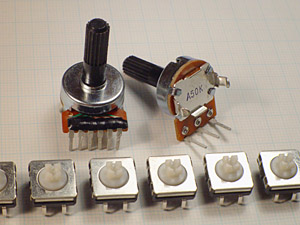
Replacing pots and switches. The tact switches underneath the 24 buttons almost always need replacing. We install Omron B3W-4050 sealed tact switches. These are sealed against dust and liquids and we expect they will last for many decades. More information about the Omron switches and why we chose them over the alternatives: tact-switches/ (We sell these specially modified Omron switches for people who want to replace the switches themselves: #tact_switch_kits .)
The six small pots along the top of the TB-303 sometimes fail. Between about 2004 and 2012 we replaced them with newly manufactured pots from Technology Transplant (this company ceased operations in 2015/16) and since 2013 we have been using pots identical to those in the Cyclone Analogic TT-303 Bass Bot. I dismantle these pots and replace the original friction grease with a lighter grade silicone grease, so the 6 small knobs are very easy to turn. I also modify them to reduce side-to-side and up-down movement, which should also prevent the edge of the rotor cutting the conductive tracks if the knob is turned while downwards pressure is applied. This was the main failure mode of the original ALPS pots. Nonetheless, please try not to apply downwards pressure on any TB-303 or TR-606 small pots while turning them.
The Tempo and Volume pots rarely fail, but I can replace them. I usually fix a noisy volume pot by dismantling and cleaning it. The two rotary switches have never failed, in my experience.
I now have a technique for spray painting the parts of the case which are worn around the 6 small pots. Where the markings and silver paint are worn away, I can spray some silver and by hand colour in new markings. Please see the refurb/ page for more on this.
There is also an option for:
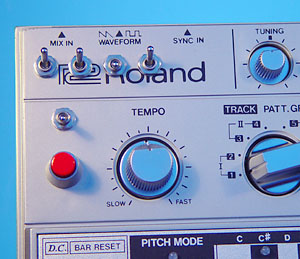
Switch for Audio In to Filter. In the Devil Fish, the old Mix In socket is used for feeding an external audio signal into the filter, in addition to whatever amount of the Oscillator is selected by the Overdrive pot. Since this pot can be turned down to zero, it is possible to run the machine without its internal oscillator and have the Filter processing purely an external signal.
With this option, a three position toggle-switch is mounted between the Tempo and Track-Pattern Group knobs. It has three positions:
This enables convenient switching of the external signal, including dropping in short bursts of it by pressing the switch to the down position, with the toggle returning to the mid position as soon as the finger pressure is released.
Up
Audio In enabled.
Mid
Audio In disabled.
Down
Audio In enabled, but spring return to Mid position.
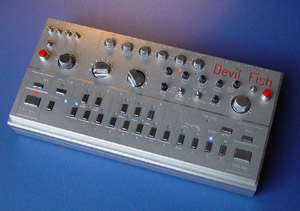
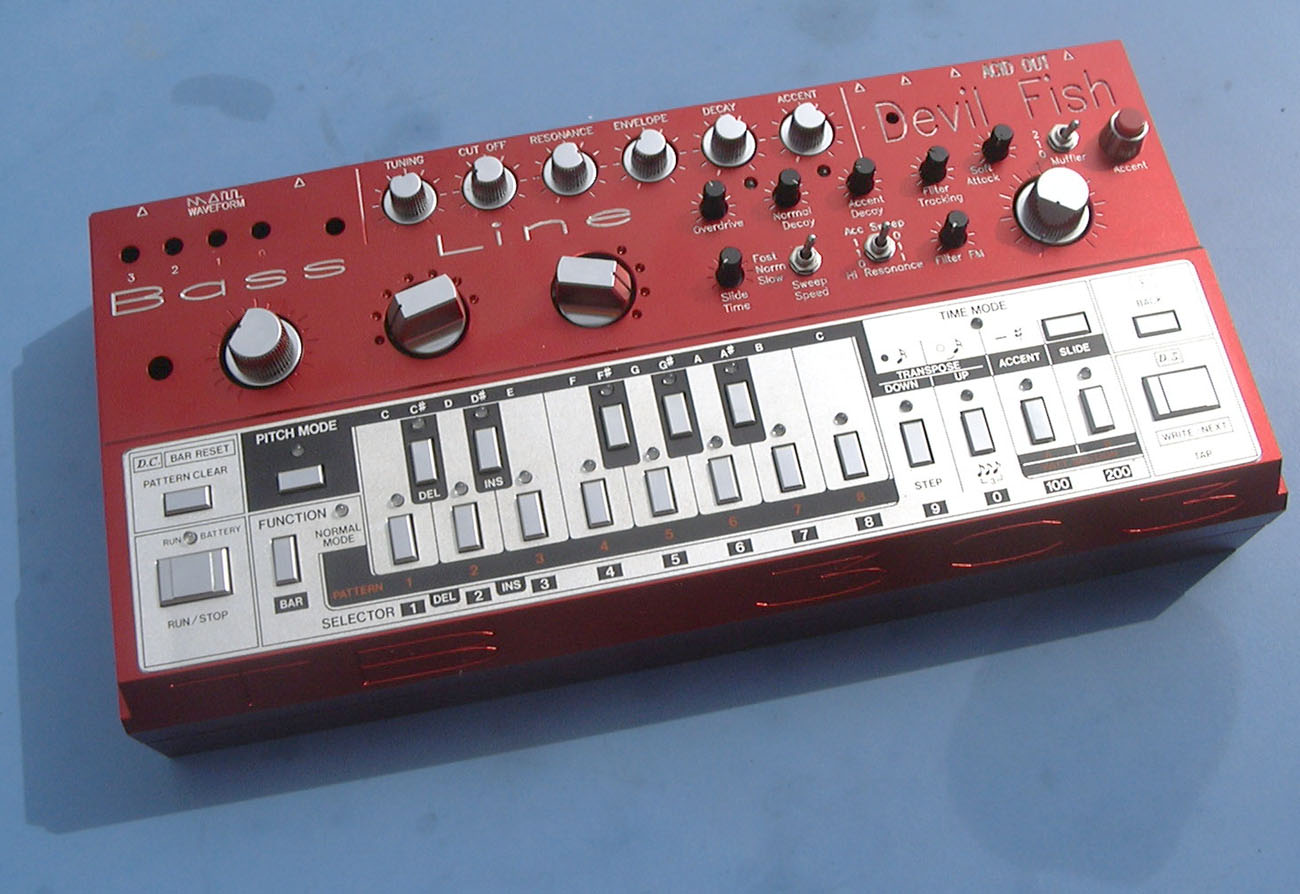
Martin Rothlisberger in Switzerland http://acid.chused to make magnificent Anodized Aluminium cases for the Devil Fish, replacing the ABS silver plastic cases which are now at least 30 years old. The email address link at that site is incorrect. Here is the proper email address: 303@acid.ch . Please see the photos/ directory for images of some AluCase Devil Fishes.
Martin is a DJ and Devil Fish musician himself. Please see the videos/ directory for him and the Liquid Trolls in action.
Please see midi-options/ for further information on these MIDI In/Out systems:
The Devil Fish MIDI In and Out system.
The SonicPotions CPU replacement system.
Click for larger version.
The Devil Fish is the most dynamic, pulsating, wailing musical instrument I know of. If you and your TB-303 have a sense of adventure, the Devil Fish modifications will propel you into musical territories dark, destructive, delicate, languid, undulating, exquisitely detailed, throbbing, luscious and lurid . . . . . Best of all, the spaces between these extremes can usually be traversed by judiciously turning a few knobs.
Tina's illustration on the Devil Fish job progress book.
Artist Robin Whittle Uniform Bass Code Charles James Linxstar Track Melodic pulsations & knobulations acidtrax2-edit cj03 Devil Fish with Mooger- Fooger Time 1.44 1:06 1:00 2:40 MP3: rw12.mp3 cw-acidtrax2-edit.mp3 cj03.mp3 Linxstar- Devil-Fish- Mooger-Fooger- edit-excerpt.mp3 24 minutes of sound samples are in the sounds/ directory.
Peter in the Netherlands has some MP3s of music he made with his Devil Fish: tek.tekmac.nl
(Translation from Strine: "How much is it?" "Strine" is Strine for "Australian". )
prices-au/ Prices for customers in Australia.
prices-int/ Prices for customers outside Australia.
The basic modification cost includes cleaning the machine and a moderate level of repair work.
There is no extra charge for removing the Kenton CV socket kit. (The Devil Fish performs all the functions of that kit, except that the Kenton kit automatically deactivates the internal sequencer's accent state, and the Devil Fish Version 2.1D and beyond enable a high Slide input voltage to drive the gate, in order to "tie together" notes which have separate Gate pulses.)
Upgrading to MIDI In or to MIDI In and Out
If you have a Devil Fish version 1.x (1993) 2.x (2006 onwards) or 3.x then I can upgrade the machine to a 4.2 version with MIDI. It is not possible to install the MIDI In system with these older Devil Fish circuit boards. This replaces the existing Devil Fish circuit boards, so your machine will have 7 new small black pots with silver lines and three new toggle-switches in the Devil Fish panel, with new CV, Gate etc. sockets at the rear.
If your machine is one of the few version 4.x machines without MIDI, the upgrade can be done with the existing circuit boards, to MIDI In or to MIDI In and Out.
If you have a 4.x Devil Fish with MIDI In, I will be able to extend this to provide MIDI Out as well. If it is an earlier version than this, then the Devil Fish boards need to be replaced with current version 5.x boards in order to provide either MIDI In or MIDI In and Out.
Set of tact switches for TB-303 or TR-606
In general, we don't sell spare parts. Please see the eBay store of Sound-to-Parts in France for many specially manufactured parts for electronic musical instruments, including new battery contacts and battery compartment doors for the TB-303 and TR-606. Many or perhaps all of these parts were originally made by Technology Transplant.
Before mid-2010, I replaced the tact switches with the original type, ALPS SKHCAA (now known as SKHCBEA010). These were not sealed against dust. Dust (mainly flakes of skin . . .) gets into the switch and builds up on the contacts, making the switches operate erratically. I installed them with a flexible plastic dust guard, which greatly prolonged their life. Still, after 10 years, some heavily used machines needed their switches replaced again. There are sealed tact switches from ALPS (SKQEAAA010), but I don't like them since they have a higher activation force, a much lower lower "click force" and a much lower "click displacement". Please see tact-switches/ for details.
The only alternative is to use Omron B3W-4050 sealed tact switches. These are pictured above: #pots_switches. These are slightly firmer than the SKHCAAs, and have about the same initial and click displacements – so they have a very good "click" action. The Omron switches have stems which are a little too wide for the TB-303 / TR-606 buttons, so I modify the stems to make them fit the buttons. This is done with a 0.6mm Dremel cutting wheel, with two cuts at right-angle through the top part of the stem.
While we can't guarantee these switches for any particular period, they are very well made and well sealed against dust and liquids. They are specified to have a life of 3,000,000 operations. Dust seems to be the only thing which makes tact switches erratic, and there's no way dust can get into these Omron switches.
The page 303-mods/ discusses how to obtain the Omron switches and how to to modify them so they fit the TB-303 buttons. To support people with the task of replacing these switches, but who do not want to modify the switches themselves, we are now selling Omron switches, with their stems modified to suit TB-303 TR-606 buttons. Each pack contains 25 switches. The TB-303 needs 24 and the TR-606 needs 21. Australian customers please email us. Overseas customers, please use PayPal to send Australian AUD$90 for one pack, or AUD$160 for two, to rw@firstpr.com.au . We will airmail them to you within a few days, so you should have them within two weeks at most.

Tina and I aim for a three week turnaround time between you, the customer, sending your TB-303 and receiving it back as a Devil Fish. However it is best to allow four to six weeks. (Note 2022 - have a large backlog of work and have not been taking on new jobs for the last two years.)
Please email us with your requirements and we will reply with the full pricing information, shipping address etc. I suggest copying and pasting from one of the Prices pages linked to from above: #emma, retaining only those lines in your email which are relevant to your desires.
Please send the TB-303 with a reputable courier company, rather than by the post. TNT, DHL, Federal Express and your Post Office's EMS service are all good choices.
The German Postpak service and a similar service from the Belgian Post Office is not a courier service and should not be used. Despite assurances about tracking numbers and someone having to sign for delivery, it will be delivered in Australia as an ordinary parcel. This means it may be left on our doorstep. Ordinary airmail with the recipient having to sign for the package is not secure enough for an item such as a TB-303. Post Offices in many countries deliver their packages not through the Post Office of the destination country, but by various transport companies. Australian truck drivers won't understand instructions in French regarding the recipient signing for the package.
Please send just the TB-303 – no batteries, vinyl carry case, or original styrofoam/cardboard box. Batteries should only be included if you do not want the 32 banks of memory and you wish to retain the existing memory contents. Memory contents cannot be retained if the 32 bank system is installed, and I can't absolutely guarantee that patterns will be retained if the memory is not installed, so please write down all important patterns before sending the machine for modification. The patch-sheet/ directory has some PDFs to help with this.
The modifications are very reliable and are guaranteed for two years. The value of a Devil Fish exceeds Australia Post's AUD$5000 limit, so we now ship the machines overseas, and potentially within Australia, using UPS. See: ../freight-insurance .
Other information at this site
It is generally best to enquire via email: rw@firstpr.com.au. We are located in Daylesford, about 120km north-west of Melbourne: Wikipedia, Google-Maps.
Sound Samples These are in the sounds/ directory. Videos There are an increasing number of YouTube videos depicting Devil Fishes, including some live acideee action by Martin Rothlisberger (Liquid Trolls) who makes the AluCases. See the videos/ directory. |
Martin Röthlisberber in Switzerland http://acid.ch custom-makes AluCases for TB-303s and Devil Fishes. These are machined from solid billets of aluminium. They are anodized and the engraved lettering hand-painted with epoxy paint. See #alucase above for more information. |

Q1: "Can the Devil Fish still make the sounds of the TB-303?"Yes. See page 7 of: Devil-Fish-Manual.pdf for how to restrict the Devil Fish to the TB-303 subset. Q2: "Does the Devil Fish have MIDI?"Yes – MIDI In. MIDI Out will soon be available. Please see the midi-options/ page for more information on this and an two other approaches to providing MIDI In and Out. Q3: "Do you have any TB-303s for sale, or do I know of any?"Sometimes. Please contact me if you wish to buy or sell a TB-303 and I may be able to put you in touch with someone. See above: #tb303sforsale . Q4: "Are you going to make a standalone Devil Fish?"One day. It is a very big project to do it as well as I believe it should be done. Q5: "Is it OK if a TB-303 has the Kenton CV/Gate/Slide/Accent/Filter input sockets?"Yes. Before doing the modifications, I remove the sockets, fill the holes with epoxy, paint them silver and then carefully drill the Devil Fish holes with my template. Q6: "My TB-303s pots are stiff. Can you replace them?"The 6 small pots (potentiometers Tuning to Accent) typically are rather stiff. This friction may be reduced if the pots have been used a lot and/or if the pots are warm. The friction in the pot is not caused by the wiper on the carbon track, but by a special part of the shaft rubbing on the case in the presence of high-viscosity silicone grease. By dismantling the pot, it is possible to remove that grease and replace it with less viscose silicone grease, which makes them move relatively freely. Q7: "The TB-303's memory contains precious patterns. Will they still be there after the Devil Fish modification?"I don't absolutely guarantee this, but I have procedures for retaining Lithium battery power to the RAM chips at all times, so your data should remain intact. Be sure to have four good C cells in the machine when you ship it. Take extra care with the packaging, especially to use tape, packaging or whatever to make sure that nothing can turn the Volume knob to the On condition. That would flatten the batteries. The patterns cannot be retained if the 32 bank memory system is installed. It is best to write your patterns down anyway. See the pattern sheets mentioned in the Other Information section above.\ Q8: "Do you install Ultra Violet LEDs?"No. UV LEDs
produce very little
visible light and plenty of UV, which may be
damaging to the eyes –
especially up close with the iris wide open in
dark conditions.
Q9: "What about spare parts, repairs to Devil Fishes and TB-303s"It used to be the case that certain parts are vital for the TB-303 and cannot be obtained from any source other than another TB-303. The problem parts are: Q10: Other maintenance questions regarding knobs, pots, switches, contamination etc.Never let anyone spray
anything
inside any
equipment
you care for!!! (With the possible exception of isopropyl
alcohol if you really know what you are doing.) Many TB-303s have
been damaged
by
people spraying oily and/or corrosive liquids inside them. It is
possible to remove the oil –
but only be removing some components and soaking the whole PCB in a
hydrocarbon resembling petrol.
Please see 303-mods/ for more information. |
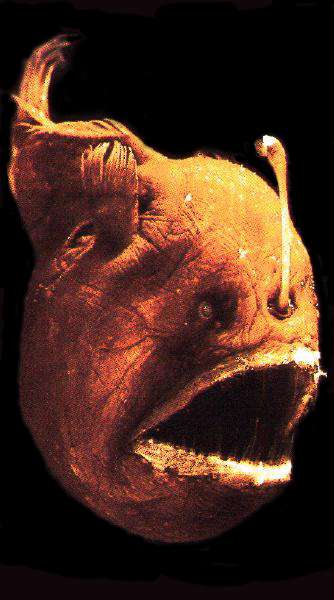
Apart from the images of aquatic Devil Fishes, and the sound samples by other people, all material in this /rwi/dfish/ section of the web site is copyright 1996-2016 Robin and Tina Whittle. If you would like to use some of this material for your own purposes, please ask: rw@firstpr.com.au .
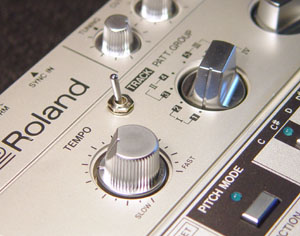
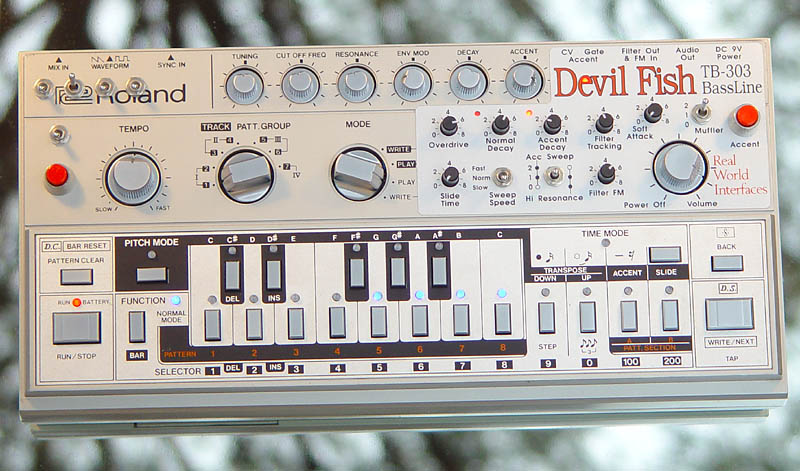
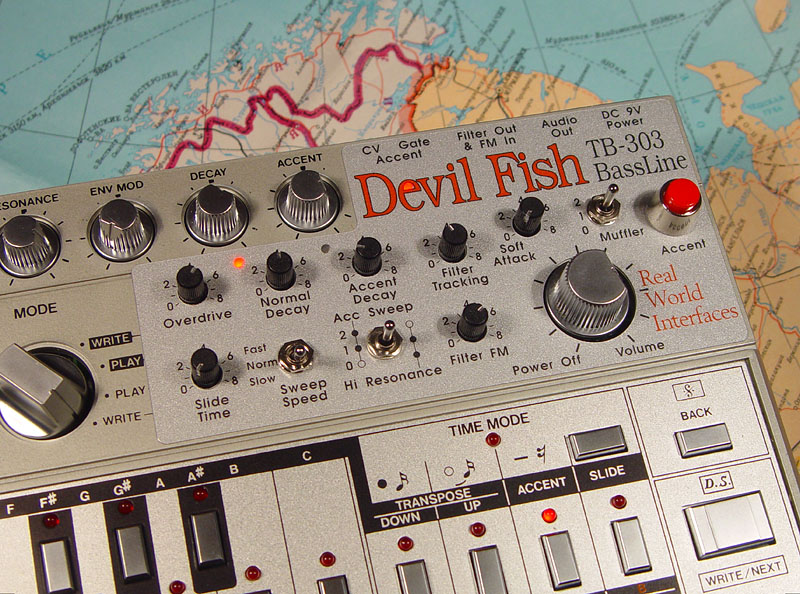
The photo at the top of this page is different for each day of the week. The photos are Devil-Fish-TB-303-front-panel-00.jpg to Devil-Fish-TB-303-front-panel-06.jpg .
If you wish to link to this site, please link to: http://www.firstpr.com.au/rwi/dfish/ and let me know. I will add your site to the links section.